
Local Businesses & the History of
Downsville, Wisconsin
Visit the village of Downsville, Wisconsin today for beautiful scenery, dining, arts, recreation, and local shopping.
What to Do in Downsville
Explore Downsville, Wisconsin, a destination for recreation and dining on the Red Cedar River. Check out this list of local parks, restaurants, and associated businesses.
Historic Downsville, Wisconsin is a great destination for a family trip or scenic drive. Our community has a number of local businesses that are making a real difference. Don’t miss the annual Discover Downsville Day celebration held each August.
Learn more about historic Downsville, Wisconsin.

The Creamery Inn & Boutique
The charming Creamery Boutique offers a selection of gifts. The historic Creamery Inn is newly renovated, offering a space for dining and events. There are five guestrooms available for rent.
Cubby’s Bar & Restaurant
Local bar and pizza, a favorite place for relaxing after work or watching sports in downtown Downsville. Cubby’s serves amazing homemade pizzas, beer, mixed drinks, and more!
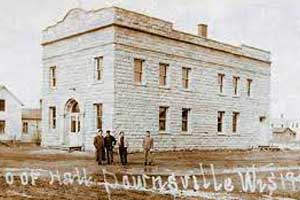
Downsville Community Museum
Downsville Community Museum preserves and promotes the history of our community, providing educational programs and opportunities. Check out the historic Empire in Pine building, also known as the Oddfellows Hall.

Jeremiah’s Bullfrog Fish Farm
Fresh, locally raised rainbow trout, pond-side fishing, tours of the hatchery, and beautifully scenic natural areas. Enjoy a shore lunch, beer, and beverages on the screen porch. Fish cut to order. No permit required. Open April – September.
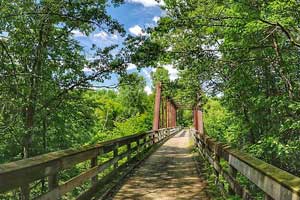
Red Cedar State Trail
This groomed trail is great for biking, walking, snowshoeing, and skiing. Tour the scenic Red Cedar River Valley, passing by native prairies, woodlands and sandstone bluffs.
Scatterbrain Cafe
A cute cafe, bakery, and coffee shop with a warm, friendly atmosphere, located in a historic building, previously the Downsville General Store. They serve breakfast and lunch menus and also offer tours.

Timber Inn
A nice, comfortable place to relax and enjoy a burger or fish fry. Well-known for their sirloin special. Great burgers and fish fry in a relaxed, local atmosphere.

Woodland Ridge Retreat
Next door to Simply Dunn. A creative getaway, the retreat offers quilting workshops and retreats along with deluxe accommodations and brightly-lit gathering rooms.
Friends & Local Businesses
Historic Downsville, Wisconsin
Downsville and the Chippewa Valley were traditionally the home of the Santee Dakota and Ojibwe people. The area became part of the Northwest Territory of the United States in 1787 and eventually the Wisconsin Territory (1836). The boundaries of Dunn and Pepin Counties were formed in 1858.
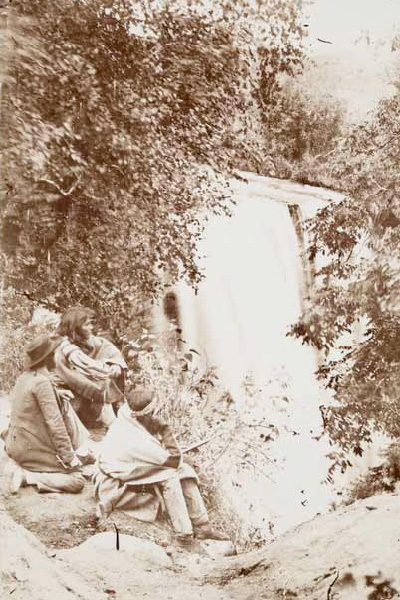
Dakota people at Mnihaha
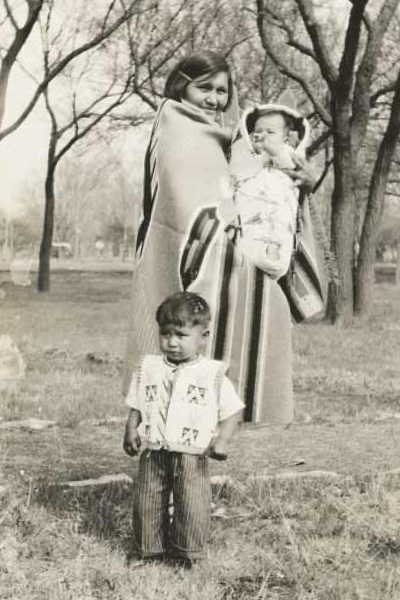
Dakota woman and children
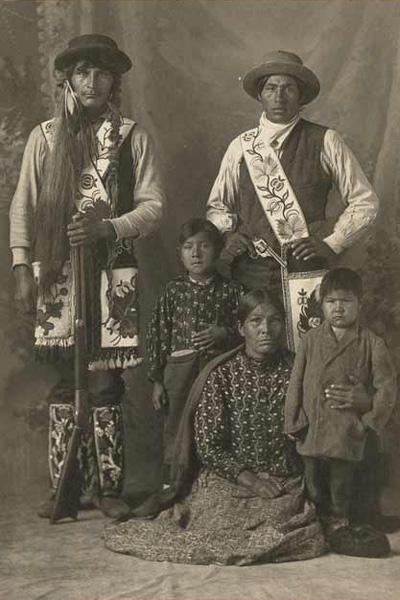
Ojibwe family
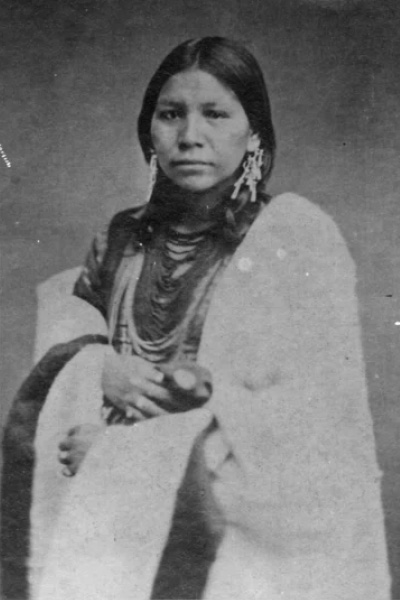
Ojibwe woman
The Santee Dakota (Santee Sioux) were the primary group of native people living in Dunn County in the 1600s and early 1700s. They varied their work and moved their villages according to the seasons, hunting, fishing, and harvesting indigenous plants, like wild rice. The Dakota grew crops like corn, beans, and squash. Their traditional lifestyle and culture are rooted in a deep connection to the land and communal support. The Dakota became involved in conflicts with refugee tribes who were moving west into Wisconsin.
The Ojibwe, (Lake Superior Chippewa) or Anishinaabeg, originated along the Atlantic Coast. Around 1,500 years ago, they left their homes by the ocean and slowly migrated westward. The Ojibwe traditionally hunted and fished, made maple sugar and syrup, and harvested native plants. Prior to the 20th century, the Ojibwe people travelled waterways in birch bark canoes and lived in wigwams. Urged by an Ojibwe prophecy, the people moved west to “the land where food grows on water,” a plain reference to wild rice.
Aligned with the French, the Ojibwe were pushed into Dakota lands as game became more scarce. They were displaced by white settlers, compelled by the US government to move west, and experienced pressure from the Iroquois in the east. In the 1700s, the largest Ojibwe settlement in Wisconsin was on Madeline Island in Lake Superior. In 1745, the Lake Superior Ojibwe began to move inland into Wisconsin. Their first permanent village was on the Chippewa River at Lac Courte Oreilles, about 100 miles northeast of Downsville.
The Dakota and Ojibwe nations competed for control of the Chippewa Valley for over a century. Hostilities eventually developed into open warfare between the bands. In 1770, the Ojibwe won a decisive battle at St. Croix Falls, about 75 miles northwest of Downsville.
When the American Revolution concluded in 1783, the United States government was granted all lands south of the Great Lakes through the Treaty of Paris. In the 1800s, daily life for the Dakota centered on survival. Communities worked together to hunt, gather food, cultivate crops, and provide for communal defense.
In 1825, Dunn County was divided at the Red Cedar River north of Menomonie by the Treaty of Prairie du Chien. The Ojibwe claimed the lands to the north, and the Dakota claimed the lands to the south, including Downsville. The US government negotiated three land cession treaties with the Wisconsin Ojibwe. In 1837 and 1842, the US acquired most of the Ojibwe land in eastern Minnesota, Wisconsin, and the upper peninsula of Michigan.
By the 1850s, the Ojibwe were successful in pushing the Dakota west into Minnesota and the Dakotas. The US-Dakota War of 1862 was followed by acts of Congress that ended all treaties with the Dakota people and removed them from their ancestral lands. A few surviving Dakota people remained in their homelands of the Mni Sota region, but most were forced out of the state.
A final treaty in 1854 ceded the last Ojibwe land in Minnesota and created four Ojibwe reservations in Wisconsin: Bad River, Red Cliff, Lac du Flambeau, and Lac Courte Oreilles. This cleared the way for American lumber barons to log the rich pine stands of old-growth forest, and for miners to exploit copper mines on the southern shore of Lake Superior.
In the early 1800s, the first white settlers arrived in the area that became the village of Downsville. A 1849 survey documented Stone’s Trading Post, located one mile upstream from present-day Downsville. The land that comprises today’s village was purchased by Ebenezer Thompson in June, 1855.
Thompson built a small saw mill on the bank of the Red Cedar River, which was soon destroyed by a flood. The saw mill had dug a small chute, which functioned as a mill race, to float logs in and out of the mill. It gradually widened throughout the years and became the new path of the Red Cedar River. In February 1858, he deeded the land and mill to Captain Burrage B. Downs, who built a dam across the river.
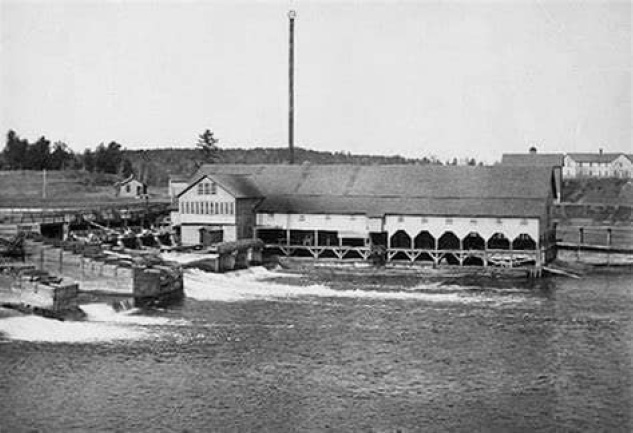
Lumber mill in Downsville, Wisconsin
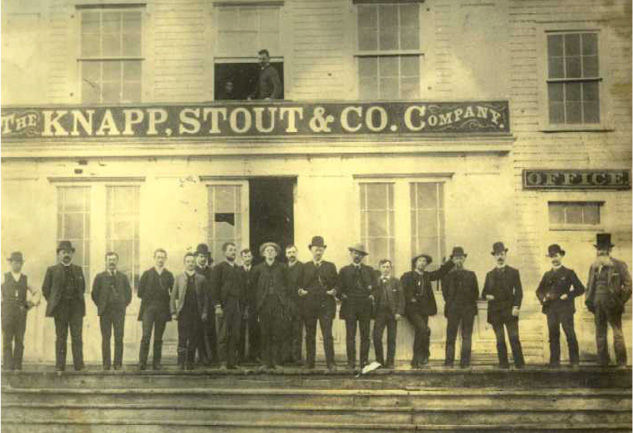
Knapp, Stout & Co. office
Downsville was officially established in 1858. As early as 1870, Knapp, Stout & Co., a large logging company, ran a boarding house and a company store that eventually housed the first post office in Downsville.
Captain Downs sold the saw mill to the company in the 1880s. Knapp, Stout & Co. employed about 100 men. The mill sawed and planed boards and produced wood shingles. The company store and boarding-house buildings are still in use as a coffee shop, Scatterbrain Coffee, and a restaurant, the Timber Inn.
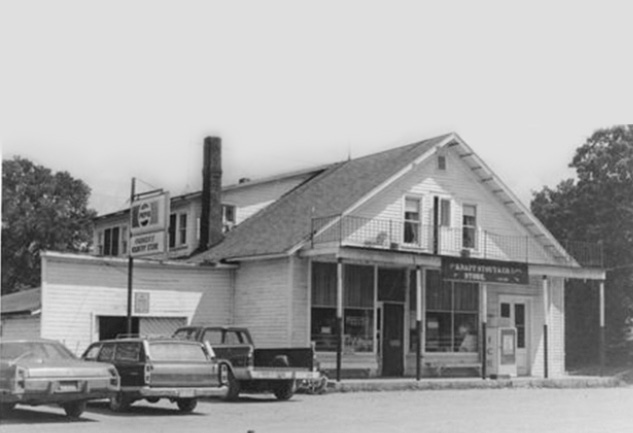
Knapp, Stout & Co. store in Downsville
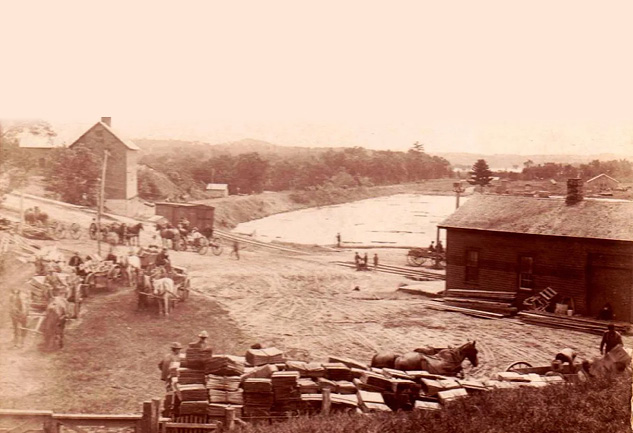
Lumber mill and depot in Downsville, Wisconsin
In the spring of 1883, the “Second Big Wash Out” flood washed away the existing dam and several buildings, including the company store and sleeping shanty. By the turn of the century, forest resources were depleted. Loggers had cut the majority of the old-growth forest in northwestern Wisconsin. In September of 1900, Knapp, Stout & Co. closed the large sawmill in Downsville, and many residents moved away from the village, so many that both the Lutheran and Methodist churches discontinued weekly services.
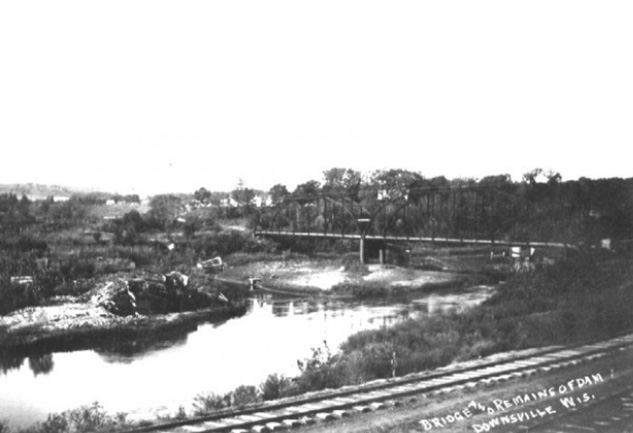
Remains of dam and bridge in Downsville, Wisconsin
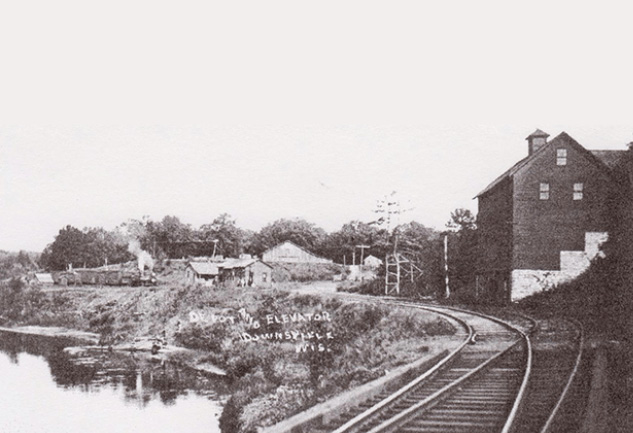
Depot and elevator in Downsville, Wisconsin
In 1905, there was a third flood that washed away the railway bridge, part of the lumber yard, and the east side of the dam. This flood rerouted the course of the Red Cedar river and created the oxbow ponds just south of Downsville. The railroad was rebuilt by Milwaukee Road, which continued to operate rail service until the early 1960s. The former rail line is now the Red Cedar Trail. In the summer of 1921, the first city water was installed for only 7 or 8 families. As late as 1925, the village did not have electrical power, and residents relied on gas lamps for light.
The Downsville Cooperative Creamery, known to be the largest in the county, was incorporated in 1903 and produced large quantities of butter. After nearly 50 years, the Downsville Creamery shut its doors in 1951. In 1977, the Creamery building was purchased by the Thomas family—Richard, John, Jane, and David—who transformed it into a restaurant and inn. The Creamery remodel was designed by Paul Thomas, architect, professor, and father to the Thomas siblings.
Paul Thomas graduated from the Illinois Institute of Technology (ITT) in Chicago, IL. He taught architecture and city and regional planning at ITT for over 40 years. Paul also worked as an architect, city planner, and landscape architect in private practice, completing residences in Illinois, Michigan, and Wisconsin, a school in Chicago, and a lodge for a summer resort in northern Wisconsin.
Renovations for the Creamery building were not completed until 1984. After 15 months of restoration and an investment of approximately $1.2 million, The Creamery opened and became a renowned Wisconsin restaurant and inn. The Creamery is under new ownership and is home to a boutique and event center with guest rooms.
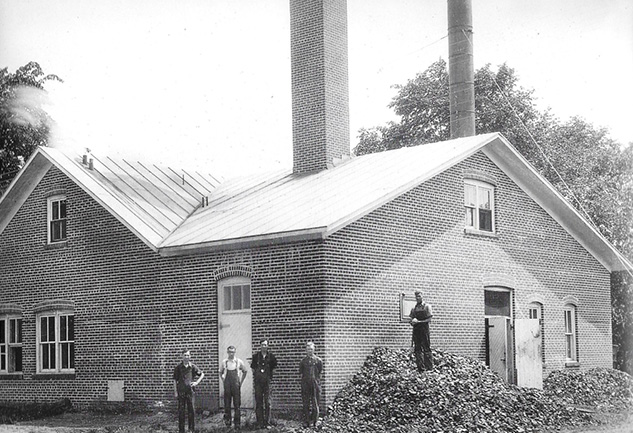
The Creamery in Downsville, Wisconsin
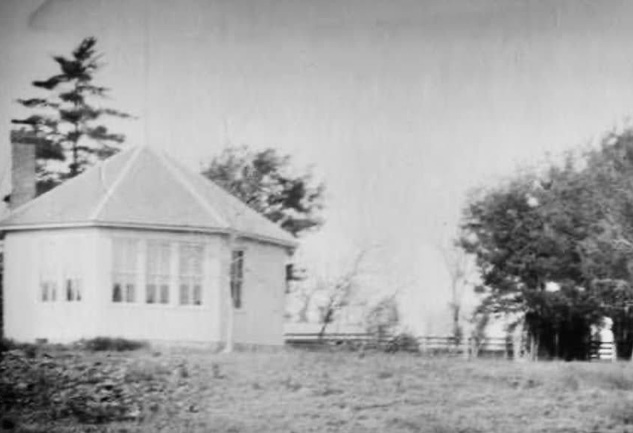
Octagonal schoolhouse in Downsville, Wisconsin
At the time it was built, the Downsville schoolhouse was one of three or four octagonal or “round schools” in the state of Wisconsin. The octagon was first used as a workshop for shop projects.
In 1866, a second, two-story schoolhouse was built on the same property. By 1907, the larger building held grades four through six upstairs and seven through nine downstairs. The younger students, grades one through three, attended school in the octagon building. The schoolhouse had no electricity through the 1920s and was heated by a central round coal heater. Outside the school buildings were typical amenities for that time: a water bucket well, “privy,” and woodshed.
Both schools were closed in the 1970s when a new elementary school was built. The old school buildings were sold at auction to Wilfred Patnode. Timber from the larger building was used to build a home that stands on the old school foundations. Dean Meachams later purchased the property, and the octagonal school eventually became the residence of Mr. and Mrs. Raymond Lauderdale. Used as a residence for many years, the schoolhouse was vacant when it was purchased by Kathy and John.
In 2007, Kathy Ruggles and John Thomas purchased the schoolhouse, and the building was relocated to their residence, one mile east of the original location. The building is 32 feet across and 800 square feet. It has a large bank of southern windows and an original hardwood maple floor. A beam in the schoolhouse is marked 1894 with the initials KS, for Knapp Stout Lumber Company, likely indicating the year it was completed.
Renovation of the schoolhouse began with the construction of a cement foundation to hold the building and create an earth-sheltered lower level. The upper portion of the foundation was later surfaced with local sandstone. The floor joists were replaced, and the wall plaster was removed to allow for the installation of foam insulation and drywall.
The floors were sanded and refinished. Antique replacement doors were added for the front door, bathroom, and a storage area. A new front porch is surfaced with bluestone slabs. The building was painted, and the window screens were replaced. A walk-out master bedroom with a garden and woodland view, along with a second bathroom on the lower level, expands the living space.
Learn more about prairie and woodland restoration at our About us page…
References
Curtis-Wedge et. al., F. (1925). History of Dunn County Wisconsin. H.C. Cooper Jr. and Co.
The Dakota People. Minnesota Historical Society.
Dunn County’s First People. Dunn County Historical Society.
Goldstein, B. (2023, April 19). How Ojibwe Tribes in Wisconsin Resisted Efforts to Deny Treaty Rights. Wisconsin Watch, PBS Wisconsin, & Person.
History. Dunn County, WI.
The History of Ojibwe and Other Wisconsin Tribes in the Nineteenth Century. Wiigwaasi-Jiimaan Birchbark Canoe.
The Knapp and Stout Company. Downsville Community Museum.
Ojibwe History. Milwaukee Public Museum.
Russell, J. (2012, June 30). Scenes of yesteryear: How down’s mill became Downsville. Chippewa Herald.
Lake Superior Chippewa Bands (Ojibwe). Wisconsin Historical Society. (2015, March 10).
Lynch, L., & Russell, J. M. (1996). Where the Wild Rice Grows: A Sesquicentennial Portrait of Menomonie, 1846-1996. Menomonie Sesquicentennial Commission.
Ojibwe Culture. Milwaukee Public Museum.